


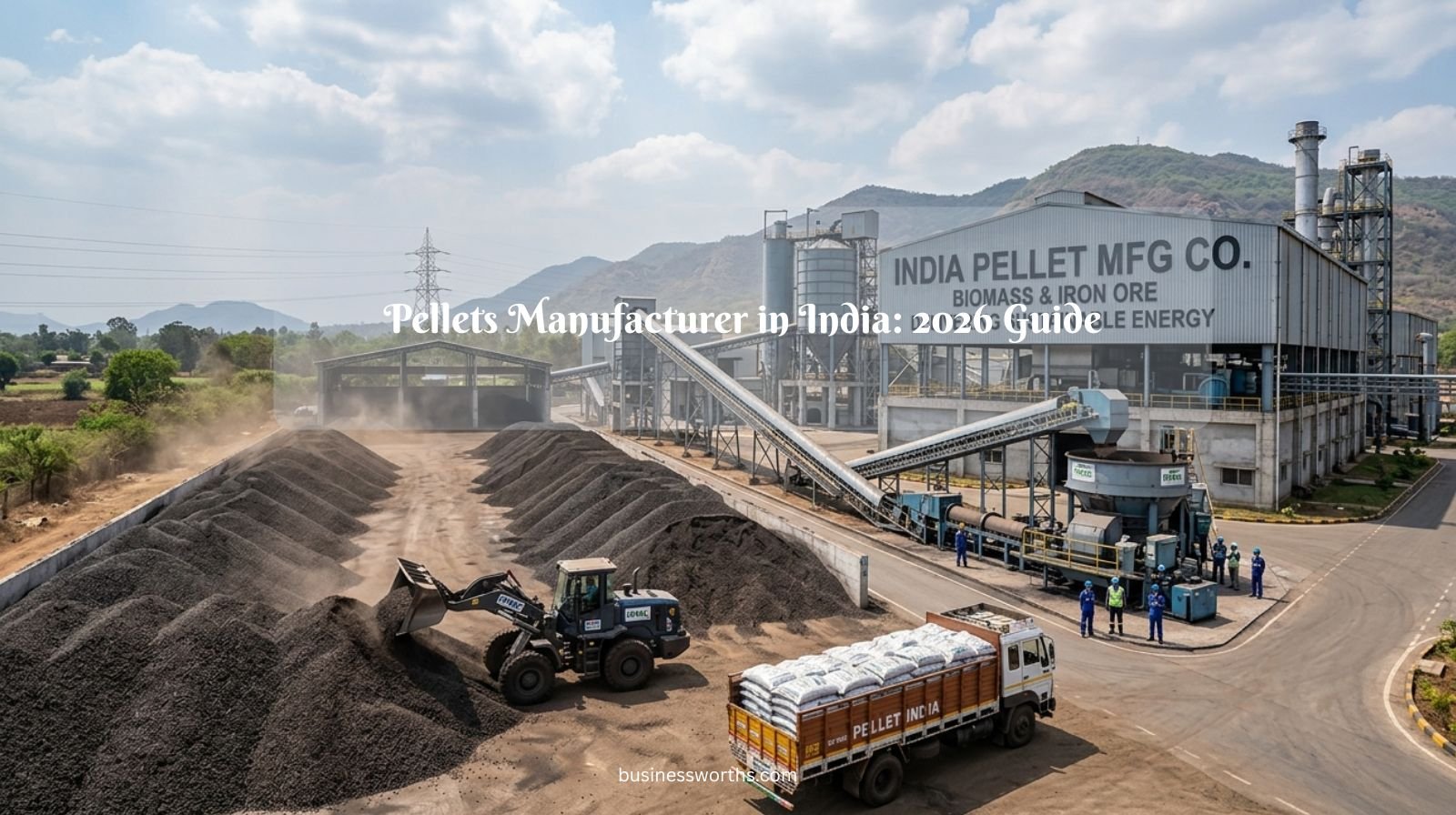
Welcome to the definitive guide on the pellets manufacturer in India landscape. Whether you are looking for biomass pellets to green your energy footprint or iron ore pellets to fuel industrial growth, the Indian market is currently in a high-growth phase.
With the Government of India pushing for sustainable energy and self-reliance in steel production, the demand for high-quality pellet manufacturing has never been higher.
1. The Rising Demand for Pellets in India
India is witnessing a massive shift toward renewable energy and efficient industrial raw materials.
The Ministry of Power has mandated biomass co-firing in thermal power plants, which has created a gold rush for biomass pellet manufacturers.
Similarly, the steel industry relies heavily on iron ore pellets to ensure high-grade production with lower emissions.
Choosing the right pellets manufacturer in India is no longer just about price—it is about calorific value, ash content, and supply chain reliability.
2. Top Biomass Pellets Manufacturer in India
The biomass pellet market is a cornerstone of the circular economy.
Manufacturers use agricultural waste like paddy straw, mustard husk, and sawdust to create energy-dense fuel.
Leading Names in Biomass:
- Ecostan Biofuel: A pioneer in providing both pellet machinery and high-grade industrial pellets.
- JP Green Fuels: Known for their consistent quality and large-scale supply to thermal power plants.
- Gattuwala Energy Solutions: A key player in the agro-waste to energy conversion sector.
These companies help reduce stubble burning, turning a seasonal environmental hazard into a year-round green fuel source.
3. Leading Iron Ore Pellets Manufacturer in India
In the metallurgical sector, iron ore pellets are the preferred choice for Sponge Iron (DRI) and Blast Furnaces.
India is one of the world’s largest producers, with plants concentrated in states like Odisha, Chhattisgarh, and Karnataka.
Key Industrial Players:
- KIOCL Limited: A giant in the public sector with a massive export-oriented pelletization plant.
- Sree Metaliks Ltd: Renowned for high-grade pellets with precise chemical compositions (63.5% Fe).
- Godawari Power and Ispat Ltd: A leader in integrated steel and pellet production in Central India.
- Rashmi Metaliks: Dominating the Eastern market with large-scale pellet manufacturing units.
4. Why the Industry is Booming in 2026
The pellet industry in India is projected to grow at a CAGR of over 25% for biomass and nearly 8% for iron ore.
The SAMARTH Mission (Sustainable Agrarian Mission on use of Agri-Residue) has been a game-changer.
It targets 7% co-firing of biomass in coal plants by 2026, requiring nearly 50 million tonnes of pellets annually.
This policy shift has turned biomass pellet manufacturing into a highly lucrative business opportunity for entrepreneurs.
5. Technical Specifications to Look For
When you contact a pellets manufacturer in India, quality benchmarks are non-negotiable.
For Biomass Pellets:
- Net Calorific Value (NCV): Should range between 3,500 to 4,500 kcal/kg.
- Moisture Content: Ideally below 10% for better combustion.
- Ash Content: Should be less than 5% to protect industrial boilers from scaling.
For Iron Ore Pellets:
- Iron (Fe) Content: Usually targeted at 63% to 65%.
- Cold Crushing Strength (CCS): Essential for surviving transportation without crumbling.
- Uniformity: Spherical shapes between 8mm to 16mm ensure optimal gas flow in furnaces.
6. Environmental and Economic Impact
Switching to pellets is a win-win for both the environment and the economy.
Biomass pellets are carbon-neutral because the CO2 released during burning was absorbed by the plant during its growth.
For farmers, selling crop residue to a pellets manufacturer provides an additional income of ₹1,500 to ₹2,500 per tonne.
For the steel industry, pelletization allows the use of low-grade iron ore fines, which would otherwise be wasted.
7. Strategic Locations for Pellet Plants
If you are looking to source or start a unit, location is the biggest cost-driver.
- Punjab and Haryana: The hub for paddy straw pellets and agro-waste aggregation.
- Odisha and Jharkhand: The heart of iron ore pellet manufacturing due to proximity to mines.
- Maharashtra and Gujarat: Rising centers for wood pellets and industrial biomass supply.
The Cost of Setting Up a Pellet Plant
Thinking of becoming a pellets manufacturer in India? The investment varies by scale.
| Plant Scale | Investment Required | Production Capacity |
| Small Scale | ₹20 – ₹40 Lakhs | 1 – 2 Tonnes/Hour |
| Medium Scale | ₹1 – ₹3 Crores | 5 – 10 Tonnes/Hour |
| Large Scale | ₹10+ Crores | 20+ Tonnes/Hour |
Government subsidies under the MNRE (Ministry of New and Renewable Energy) can cover up to 20% of the capital cost for biomass units.
Future Trends: Torrefied Pellets
The next big thing in the Indian market is Torrefied Pellets, also known as “Black Pellets.”
These are produced through torrefaction (heating in the absence of oxygen), making them hydrophobic and energy-dense.
Unlike white pellets, black pellets can be stored in the open and have a calorific value close to bituminous coal.
Major utilities like NTPC are already floating tenders specifically for torrefied biomass pellets.
How to Choose the Best Manufacturer?
With hundreds of suppliers on the GeM Portal and B2B directories, selection can be tough.
- Check Certifications: Ensure they follow IS 19410:2026 standards for biofuels.
- Verify Capacity: Can they handle bulk orders during peak winter or industrial seasons?
- Logistics: Choose a pellets manufacturer with a strong transport network to minimize landed costs.
- Trial Runs: Always ask for a test batch to check the actual burning efficiency in your specific boiler or furnace.
Conclusion: A Green Industrial Revolution
The role of a pellets manufacturer in India has evolved from a niche supplier to a critical energy partner.
Whether it’s heating a rural home or powering a massive steel plant, pellets provide a sustainable, efficient, and cost-effective fuel solution.
As India moves toward its Net Zero 2070 goals, the pellet industry will be the engine driving this transition.