

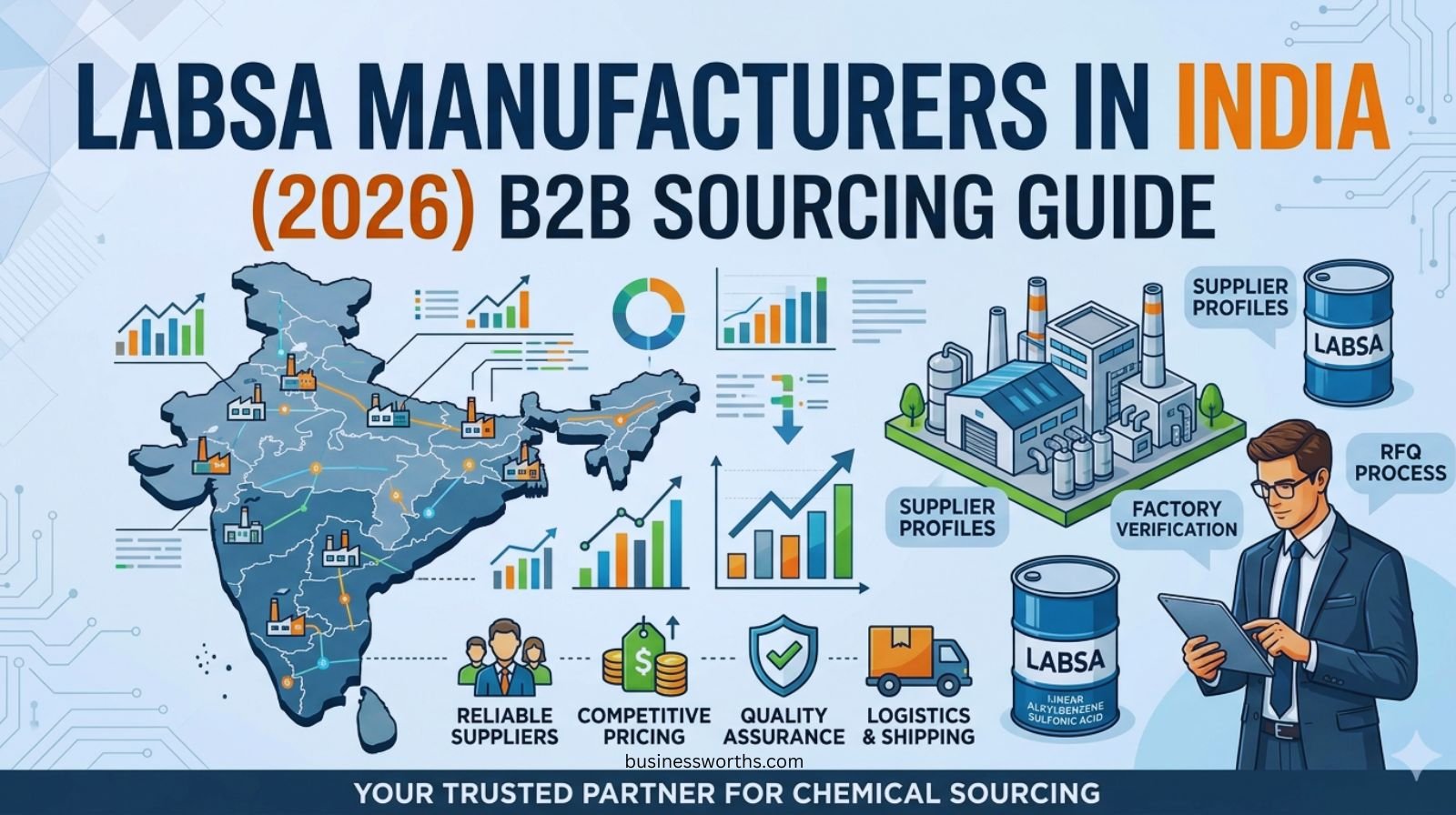
In the vast, bubbling world of industrial chemicals, one molecule reigns supreme as the “workhorse” of the detergent industry: Linear Alkyl Benzene Sulphonic Acid, universally known as LABSA. As we navigate through 2026, India has solidified its position as a global manufacturing powerhouse, providing the high-purity surfactants that keep the world clean.
Whether you are a medium-scale detergent formulator or a global FMCG procurement head, finding a reliable LABSA manufacturer in India is the cornerstone of your product’s performance. In this exhaustive guide, we explore the giants of the sector, the chemistry that drives cleaning power, and the market trends defining the future of sulfonation technology.
What is LABSA and Why Does it Matter?
Before identifying the industry leaders, it is crucial to understand the scientific weight this chemical carries. LABSA 96% is the most widely used synthetic surfactant due to its high performance and relatively low cost.
- Powerful Detergency: It is a high-foaming anionic surfactant that excels at removing stains and grease.
- Biodegradability: Unlike older branched versions (DBS), Linear Alkyl Benzene Sulphonic Acid is eco-friendly and breaks down easily in the environment.
- Versatility: Beyond laundry powders, it is a critical ingredient in liquid detergents, dishwashing bars, and industrial cleaners.
Top LABSA Manufacturers in India: The 2026 Market Leaders
India’s sulfonation capacity is concentrate among a few massive players who control the supply chain from the raw material (Linear Alkyl Benzene) to the finished acid.
1. Reliance Industries Limited (RIL)
As a global energy and petrochemical giant, Reliance is the primary source of LAB (Linear Alkyl Benzene) in India. Through their extensive network, they remain the most stable LABSA supplier for large-scale industrial contracts.
- Key Advantage: Complete backward integration ensures price stability even during global oil fluctuations.
- Purity Standards: Known for producing LABSA 96% with minimal free acid content.
2. Nirma Limited
What started as a backyard detergent experiment is now one of the world’s largest soda ash and LABSA manufacturers. Nirma produces a significant portion of India’s sulphonic acid for its own consumption and merchant sales.
- Focus: High-volume production with an emphasis on cost-efficiency.
- Infrastructure: Their state-of-the-art sulfonation plants in Gujarat utilize the latest falling-film technology.
3. Fogla Group
The Fogla Group has emerged as a specialized leader in the detergent chemicals space. They are a preferred partner for international buyers looking for high-quality export-grade LABSA.
- Export Prowess: They have a massive footprint in over 50 countries, specializing in tailored formulations.
- Quality Control: Their labs are equipped for rigorous testing of color, active matter, and viscosity.
4. Kadvani Chemicals
A dominant force in the Western Indian chemical belt, Kadvani Chemicals has built a reputation for reliability and rapid delivery.
- Technology: They utilize modern continuous sulfonation processes to ensure every batch of LABSA is identical in performance.
- Customer Service: Highly favored by MSMEs for their flexible order quantities and transparent pricing.
5. Godrej Industries (Chemicals)
Godrej is a pioneer in the oleochemicals and surfactants space. While they have a diverse portfolio, their LABSA production is highly sought after by premium cosmetic and home care brands.
- Sustainability: Godrej leads the way in green manufacturing practices and waste reduction.
The Sulfonation Process: Engineering Quality
High-quality LABSA isn’t made by accident. It is the result of a precise chemical reaction between Linear Alkyl Benzene (LAB) and Sulphur Trioxide ($SO_3$).
- Sulphur Burning: Pure sulphur is burn to create $SO_2$, which is then convert to $SO_3$ gas.
- The Reaction: In a falling film reactor, LAB is reacted with $SO_3$ under strictly controlled temperatures. If the temperature is too high, the product turns dark; if too low, the reaction is incomplete.
- Digestion and Hydration: The crude acid is “aged” to ensure all LAB is convert, and a small amount of water is added to stabilize the product.
Why Source LABSA from India?
The global shift toward Indian chemical suppliers is driven by several strategic factors:
- Raw Material Proximity: With RIL and IOCL producing massive quantities of Linear Alkyl Benzene, Indian LABSA manufacturers have a domestic supply of feedstocks.
- Strategic Logistics: Major plants are located near the ports of Kandla, Mundra, and JNPT, facilitating seamless global exports to Africa, the Middle East, and SE Asia.
- Advanced Sulfonation Technology: Most Indian plants have upgraded to Italian or German sulfonation technology, ensuring color scores as low as 20-30 Klett.
- Competitive Pricing: The scale of production in India allows for bulk pricing that is often more competitive than Chinese or European alternatives.
2026 Quality Standards: What to Look for in a Supplier
In today’s market, “just any” chemical won’t do. A premium LABSA manufacturer in India must meet these 2026 benchmarks:
- Active Matter: Should be consistently 96% or higher.
- Free Oil Content: High-quality manufacturers keep “unsulfonated matter” (free oil) below 1%, which prevents your detergent from feeling greasy.
- Free Sulphuric Acid: Excess acid can damage packaging and irritate skin; the best suppliers keep this below 1.5%.
- Color Grade: For liquid detergents, a light, honey-colored LABSA is essential. Always check the Klett color value.
Sustainability and the “Green” Shift in LABSA Production
By 2026, the industry is no longer just about cleaning clothes; it’s about cleaning up the process.
- Zero Liquid Discharge (ZLD): Top Indian manufacturers have implemented ZLD systems to ensure no chemical waste enters the water table.
- Renewable Energy: Plants in Gujarat and Tamil Nadu are increasingly power by solar and wind energy.
- Waste Heat Recovery: The exothermic heat from the sulfonation reaction is now being captured to generate steam for other plant processes.
Impact on the Indian Detergent Industry
The availability of high-grade LABSA has fueled the growth of domestic brands. From “Value” segments to “Premium” liquid pods, the surfactant quality provided by these manufacturers is the reason Indian detergents are now competing with global giants.
| Product Type | Recommended LABSA Usage | Key Benefit |
| Laundry Powder | 10% – 15% | High foam and stain removal |
| Liquid Detergent | 8% – 12% | Instant solubility and cold-wash efficacy |
| Dishwash Bars | 5% – 10% | Hard water tolerance and degreasing |
| Industrial Cleaners | 15% + | High-concentration grease cutting |
How to Evaluate a New LABSA Supplier
If you are transitioning to an Indian LABSA supplier, follow this 2026 audit checklist:
- Sample Testing: Always request a 1kg sample to test for active matter and solubility in your specific formulation.
- Plant Capacity: Ensure the manufacturer has the capacity to handle tanker-load deliveries during peak seasons.
- MSDS & COA Documentation: Check for updated Material Safety Data Sheets and batch-wise Certificates of Analysis.
- Credit and Logistics: Evaluate their ability to offer flexible payment terms and door-to-door logistics through reliable tankers.
The Future: Beyond LABSA 96%
As we look toward 2030, the industry is moving toward even higher concentrations and specialized alpha-olefin sulfonates (AOS). However, for the foreseeable future, LABSA remains the king of surfactants.
India’s role as a LABSA manufacturing hub is not just about volume; it’s about a commitment to chemical excellence. By partnering with the right manufacturer, businesses can ensure their products deliver that “perfect clean” that consumers demand.
Summary Table: Top Indian LABSA Players
| Manufacturer | Location Focus | Primary Strength |
| Reliance Industries | Patalganga / Gujarat | Raw Material Control |
| Nirma Ltd | Gujarat | Economy of Scale |
| Fogla Group | West Bengal / Gujarat | Global Export Expertise |
| Godrej Industries | Maharashtra | Premium & Sustainable Grades |
| Kadvani Chemicals | Gujarat | Supply Chain Speed |